Emergency Glass Repair Options for Downtown Buffalo Retail
Downtown Buffalo retail operators live with a simple truth. If the front glass fails, business stops. A break-in at 2 a.m., a wind-driven impact on a Saturday, a closer failure that slams a door and pops a tempered panel during the lunch rush on Chippewa Street. The storefront must be secured fast, the glass specified correctly, and the door hardware reset so customers and staff can move safely. That is the core of emergency glass repair for Buffalo retail and restaurant properties.
This article explains practical options Buffalo decision-makers use when a panel shatters or a door glass cracks. It covers board-up choices, tempered versus laminated glass replacement, insulated glass unit rebuilds, and what to do when the problem involves the door hardware that holds or swings that glass. Everything is framed for real properties between Canalside and the Theatre District, out through Allentown, Elmwood Village, and the Medical Corridor. It reflects the weather Buffalo gets from Lake Erie, the building archetypes on Main Street and Niagara Street, and the high cycle counts at street-level retail along Elmwood Avenue and Hertel Avenue.
Why Downtown Buffalo storefront glass fails and what that means for the next 24 hours
Buffalo retail glass emergencies fall into a few recurring profiles. Break-in or forced entry, vehicle or cart impact, thermal stress across large insulated glass units, wind-borne debris in storms, and hardware failure that lets a door slam and fracture a panel. The location matters because Downtown Buffalo, the Cobblestone District, and the Canalside waterfront see higher winds than sheltered suburban plazas. Wind off Lake Erie averages about 12 mph at the airport with much higher gusts during storm events. Those gusts catch doors and load the glass and hardware. High pedestrian counts on Allen Street and Main Street lead to more door cycles, which add wear on pivots and closers that support the glazed door leaf.
Lake-effect winter patterns push temperatures below 20°F, the point where hydraulic door closer fluid thickens and loses damping consistency. When closers lose control, doors slam. A slam with a misaligned latch can crack a glass lite at the edge. Road salt tracked in from sidewalks attacks the bottom pivot pockets and thresholds. Corroded pivots let the door sag, which drags the glass edge or meeting stile and raises break risk. These are Buffalo-specific facts that change how emergency glass calls get triaged compared to calmer markets.
Board-up first, glass replacement second
Board-up is the immediate step after glass loss. Emergency board-up means securing the opening with plywood or OSB and temporary fasteners so the space is weather and theft resistant while new glass is measured and fabricated. It is common to board up at night and install glass the next day on common sizes. Oversized tempered lites, custom laminated make-ups, and insulated glass units often take longer due to fabrication lead time. The downtown locations around 14202 and 14203 tend to need discrete board-ups that keep entrances partially open for egress and ADA access where possible. That can include partial height panels and temporary swing hardware around door openings while the primary lite is on order.
For restaurant and retail doors that remain in service during the board-up period, climate and wind exposure matter. In the Theatre District and along emergency commercial door repair Washington Street, wind funnels between buildings. Technicians will brace the board-up so it resists suction and pressure from gusts. On multi-tenant corridors like Main Street or Franklin Street, board-ups must preserve egress width and door swing, which can require on-the-spot hardware solutions rather than a flat panel over the full frame.
Choosing the right replacement glass under pressure
Emergency glass work is a specification decision as much as a labor decision. Using the wrong glass causes future failures or code problems. The most common Buffalo storefront glass categories are tempered glass, laminated safety glass, and insulated glass units. All safety glazing in doors and adjacent sidelites must meet ANSI Z97.1 for impact safety. Door lites and sidelites down to the floor must be safety glass, not annealed. Each type has a role.
Tempered glass for doors and active areas
Tempered glass is heat-treated safety glass. When it breaks, it crumbles into small pellets. It is common for single-pane door lites and narrow sidelites in aluminum storefront doors. The standard thickness on many Buffalo aluminum doors is 1/4 inch tempered per ASTM C1048. Heavier doors sometimes run 3/8 inch or 1/2 inch tempered, often in restaurants and big-box entries where abuse is higher. Tempered cannot be cut after heat treating. That means the opening must be field measured with accuracy before ordering. In emergencies with common sizes, pre-stocked blanks can be cut before tempering at the fabricator and sometimes turned around the same day if the line is available. If the size is custom or the hole patterns for handles are specific, next-day is a more realistic goal.
Laminated glass where forced-entry resistance is a goal
Laminated safety glass is two pieces of glass bonded with an interlayer. When it breaks, the pieces adhere to the interlayer and the pane tends to stay in the frame. Laminated is useful for high-risk locations on Chippewa Street nightlife corridors, ATM vestibules near the Medical Corridor, and pharmacies across 14202 and 14203. It meets ASTM C1172. Laminated can be cut to size before lamination, so custom fit is normal. It takes longer to fabricate than simple tempered. Many Buffalo operators pick laminated for transoms or sidelites but still use tempered in the swinging door for weight and closer control reasons. A special laminated makeup with stronger interlayers can raise forced-entry resistance, but exact ratings depend on the product and are not implied unless tested.
Insulated glass units in larger fixed storefronts
Insulated glass units, often called IGUs, are two or more panes separated by an air or gas space and sealed as one unit. They provide thermal performance in large fixed panels. ASTM E2190 is the IGU durability standard. A typical retail storefront might use a 1 inch IGU made from two 1/4 inch panes with a 1/2 inch spacer. Some use low-E coatings to reduce heat loss. Edge seal failures show up as fogging. In emergencies where one pane is shattered, the entire IGU must be replaced. Temporary board-up is needed until the new IGU is fabricated. Rush fabrication on standard sizes can be quick, but shaped or oversized IGUs will take longer. Many downtown buildings near Canalside updated to IGUs in recent years, so a site walk confirms whether the broken panel is single tempered or part of an Additional info IGU stack.
Door hardware matters in a glass emergency
Shattered glass does not always start as a glazing problem. Aluminum storefront doors depend on pivots, closers, and locks. If those fail, the door moves in ways glass cannot tolerate. A pivot hinge is the hardware that rotates an aluminum storefront door on a fixed pin at the top and bottom rather than on side-mounted butt hinges. When the bottom pivot bearing corrodes from salt tracked in off Washington Street, the door sags and the glass edge can chip or crack. A hydraulic door closer is the box that controls door speed with oil. When seals fail in Buffalo cold, the closer leaks oil and loses control. The door slams, and the shock can fracture a lite.
Buffalo’s common storefront brands include Kawneer, Tubelite, YKK AP, Vistawall, US Aluminum, and heavy-duty Ellison Bronze balanced doors on some historic entries. A familiar narrow stile door is 2-1/8 inch wide at the vertical rail and often uses Adams Rite locks. A medium stile door is 3-1/2 inch and a wide stile is about 5 inch. The stile width affects hardware hole locations and glass size. On narrow stile doors, replacing the glass without addressing a failed closer guarantees another failure under wind load. That is why Buffalo emergency glass service often includes a quick pivot and closer check while the opening is secured.
Specific hardware that often shows up during a glass call
LCN 4040 series surface closers are common across Elmwood Village and Allentown. Norton 1600 and 8000 series are also widespread. Concealed overhead closers like the Dorma RTS88 or Rixson floor closers show up on cleaner, modern entries along Main Street and at downtown office towers. For pivots, Kawneer TH1118 offset pivot sets and the 050331 intermediate pivot are staples on taller doors above about 7 feet 6 inches. The intermediate pivot is a mid-height stabilizer that reduces door twist and glass stress. When that intermediate is worn, the torsion loads increase on the top and bottom pivots and on the glass stops. Adams Rite MS1850 series deadbolts and narrow stile deadlatches are the usual locks on Buffalo aluminum doors. A latch that is out of alignment can point-load the glass at the edge during closing and chip it.
Emergency scenarios Buffalo retailers actually face
Downtown storefronts and restaurant entries across 14202 and 14203 experience the same core emergencies, but the street conditions change the response. The Theatre District and Chippewa nightlife corridors often see break-in damage where the priority is lock replacement or cylinder rekey in addition to the glass. The Canalside and Cobblestone District areas see wind and pedestrian patterns that require faster closer replacement to avoid a second failure after the glass is set. Offices along Washington and Ellicott balance aesthetics with secure board-ups so tenants can enter for work without a visual shutdown.
- Break-in damage where tempered door glass is blown out and the Adams Rite cylinder is forced. Board-up is immediate, cylinder is replaced, and a new tempered lite is ordered to spec. Vehicle or cart impact at a corner lite on Main Street where an insulated glass unit shatters. The frame is inspected for racking, board-up is braced, and an IGU is measured for fabrication. Wind gust catches a door at Canalside, the closer arm bends, and the door slams. The glass cracks at the edge. The closer is replaced and the glass set after alignment. Winter freeze splits a worn threshold at 14204 Broadway-Fillmore. Bottom pivot pocket fills with slush, the pivot seizes, and the door binds, chipping the glass. Pivot is replaced, pocket cleared, and tempered lite reset. Thermal stress on a south-facing Elmwood Village window with dark film causes a crack. Window is boarded and laminated or tempered replacement is specified based on location and risk.
Automatic entrances and glass: extra steps for safety and compliance
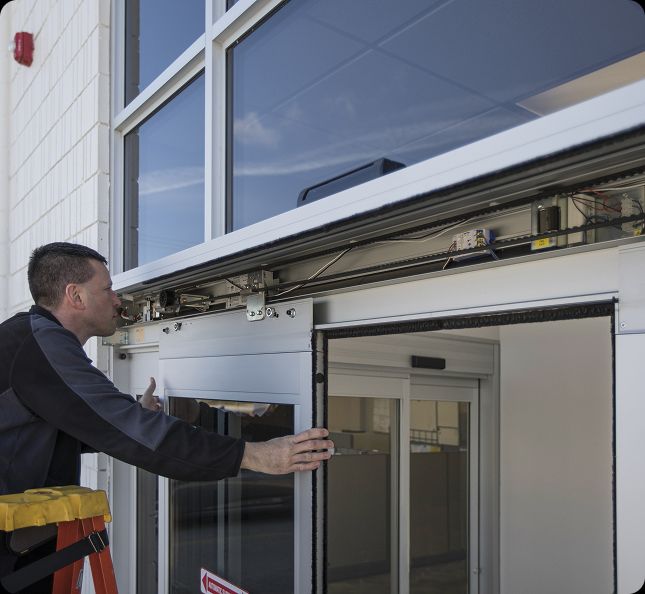
Downtown retail in the Medical Corridor and near Sahlen Field often runs automatic sliding or swing doors to meet accessibility goals. When those lites break, there is both a glass job and a controls job. Automatic sliding door repair requires sensor checks and an AAADM safety review because ANSI A156.10 governs automatic sliding doors and ANSI A156.19 governs low-energy swing operators. After replacing a glass panel in an automatic assembly, technicians must verify presence detection, threshold protection, and closed force within ADA guidance, often targeted around 5 lbf on interior low-energy operators. If a door leaf was removed for boarding, the operator needs recalibration and belt or arm inspection before returning to service. Record brand entrance solutions are common downtown, as are Stanley, Besam ASSA ABLOY, and Horton units in public-facing buildings. An AAADM-certified technician should return these units to service after a glazing event.
Brands and storefront systems that shape Buffalo emergency choices
Most Downtown Buffalo storefront frames fall into standard aluminum storefront systems. Kawneer Trifab 350, 400, 450, and 500 series, Tubelite T14000 and T24000, and YKK AP YES 45 XT or YES 60 XT dominate the field. Legacy Vistawall systems appear in many 1960s to 1980s plazas and some downtown retrofits. Those frames take standard glazing stops, so tempered or laminated lites can be sized and set quickly once measured. Door leaves are typically Kawneer 190 series narrow stile or similar YKK and US Aluminum equivalents. The brand affects pivot and closer footprints and sometimes the glass bite dimension, which is the amount of glass captured by the stop. That bite must be correct to avoid blowout under wind suction on exposed corners like Delaware Avenue at Niagara Square.
On wider institutional doors, heavy-duty closers like the LCN 4110 series and Von Duprin 98/99 Series exit devices show up. A broken glass event on those openings often links to backcheck failure. Backcheck is the closer feature that resists a door being thrown open. If backcheck is not strong enough for Buffalo wind patterns across the Waterfront, hinges and glass take the load. Repair typically includes backcheck reset or closer upgrade, not glass only.
Where Buffalo weather changes the emergency playbook
Buffalo sits at the east end of Lake Erie and gets one of the highest annual snowfall totals among large U.S. Metros. Lake-effect patterns concentrate snow and ice. The freeze-thaw cycle breaks down perimeter gaskets and lets water into glazing pockets. Then temperatures swing, the water expands, and pressure chips the glass edge or causes minor frame racking that weakens bite pressure. Wind gusts in storm events reach 40 to 60 mph in the metro. A glass panel with poor bite or a door with a weak closer will not last in those gusts on streets like Main and Washington where buildings funnel the wind. These are the reasons fall pre-winter maintenance is valuable, but in emergencies they are the reasons to check pivots, closers, gaskets, and thresholds before setting new glass.
What a fast, Buffalo-ready emergency response looks like
A practical emergency response for downtown retail includes immediate dispatch, board-up materials on the truck, common hardware in inventory, and a plan for next-day glass when possible. Stocked trucks carry plywood and OSB, screws and temporary braces, weatherstripping, Kawneer TH1118 pivot sets, 050331 intermediate pivots, LCN 4040 closers, Norton 8000 series closers, Dorma RTS88 components, Adams Rite MS1850 deadbolts and narrow stile deadlatches, and tempered blanks in common panel sizes. Those blanks handle the typical single-door lite sizes found in narrow stile doors. Anything custom or insulated is measured for fabrication with a board-up in place. The technician checks the frame for racking, verifies the threshold is sound, evaluates the top and bottom pivots, and resets latch alignment to protect the new glass.
How to choose between tempered, laminated, and IGU under time pressure
The best choice weighs safety, lead time, security, and environment. A door leaf on Elmwood Avenue that sees 1,000 or more cycles a day does well with tempered because the weight is lower and the closer can control it despite winter fluid thickening. A pharmacy or jewelry case in the 14202 corridor may pick laminated in the fixed sidelite for an extra layer of forced-entry resistance while keeping tempered in the active door. A large fixed display window in the Theatre District usually uses an insulated glass unit for condensation and energy reasons. If the failure is from break-in, laminated offers better temporary integrity after cracking. If the failure is from wind slam, upgrading the closer and ensuring adequate bite in the stop may be the most important step regardless of glass type.
Door size, stile width, and hardware hole patterns influence glass timing
Narrow stile aluminum doors at 2-1/8 inch stile width were designed for light, replaceable glass and slim hardware like Adams Rite paddles and deadlatches. Medium stile at 3-1/2 inch and wide stile at 5 inch accept heavier glass and different hardware footprints. If a door has thru-glass pull handles, those holes must be drilled before tempering or lamination. That decides the fabrication lead time. If the door uses surface pulls and the glass is clear, a pre-sized tempered blank might be available from stock. Downtown operators in 14202 can often get a new tempered door lite set the same day or the next morning if a standard size fits. Laminated or IGU panels will trend to next-day or later depending on backlog. Field crews will explain those timelines on site because Buffalo fabricator capacity varies by day and by storm events.
Coordination with fire and egress codes during emergency work
Even in emergencies, commercial egress and safety rules remain in force. NFPA 101 Life Safety Code and IBC Chapter 10 govern egress, and ANSI Z97.1 governs safety glazing at doors. A board-up cannot block required exit width. Temporary hardware must allow one motion egress where panic hardware is required. Panic exit devices like the Von Duprin 98/99 Series need to function after a board-up and during interim use. In automatic sliding doors, ANSI A156.10 requires verified sensor coverage before returning the opening to automatic mode. In low-energy swing operators, ANSI A156.19 and ADA force targets guide adjustments. A crew that understands code will set a board-up that passes an inspector walking by on Washington Street or a property manager in 14203 who needs the shop open for the morning rush.
Local building archetypes shape the fix
Early 20th century brick storefronts along Main Street, Allen Street, and Grant Street often carry retrofit aluminum frames from the 1960s to 1990s. Those frames can rack in vehicle impacts, which changes how glass sets. Mid-century strip plazas outward toward Cheektowaga and West Seneca use standard Kawneer or Vistawall frames where stop and gasket replacement is quick. Downtown office and medical buildings on the Buffalo Niagara Medical Campus run automatic entrances with low-energy operators or sliding packages, which adds sensor reset and AAADM inspection steps to any glazing event. Big-box and mixed-use near the KeyBank Center and along South Park Avenue tend to use large IGUs that need accurate measuring and careful bracing on board-up due to wind exposure. Each property type shifts the time and material plan, so crews must know the buildings and the weather they sit in.
What emergency glass work typically costs and how scope affects it
Emergency glass service pricing varies with glass type, size, after-hours timing, and whether hardware is included. Across the market, a basic overnight board-up lands in a few-hundred-dollar band in regular hours and more after-hours. Tempered door lites often total in the low-hundreds to low-thousands depending on thickness, holes for pulls, and finish grade. Laminated and insulated units trend higher and move into the mid to higher ranges when size or coatings get complex. Exact numbers require an on-site estimate because Buffalo jobs differ by building age, wind exposure, and hardware condition. Many retailers on Elmwood Village and Hertel Avenue commission preventive work in the fall to cut emergency calls, which saves considerably versus after-hours rates during storms.
Why hydraulic closer problems and pivot corrosion should be solved during a glass call
Resetting glass without solving the slamming or sag problem is a short-lived fix. Hydraulic door closers lose damping when fluid thickens below 20°F. That is a normal Buffalo winter night. If a closer is already leaking oil, the next cold snap will push it over the edge. A door that slams can shatter tempered glass even when the set is perfect. Pivot corrosion from road salt at the bottom pocket is a winter certainty in the 14202 Downtown zone. That corrosion lifts and loosens the door pivot pin, which lets the door twist. The twist puts uneven loads on the glass and the stop. Replacing the pivot when glass is out is quicker and cheaper than another board-up after a second failure. The cost difference between proactive pivot replacement and another emergency after-hours response plus potential glass is material, especially when a door fails open during business hours and security is compromised.
What a Buffalo-ready truck carries for single-visit outcomes
Trucks that complete most emergency calls in one visit carry a precise set of parts. Common tempered blanks in standard door sizes for quick set on narrow and medium stile doors. Adams Rite cylinders and MS1850 deadbolts to restore lock function. LCN 4040 and Norton 8000 closers to regain control immediately. Kawneer TH1118 and 050331 pivots to cure sag and twist. Weatherstripping, EPDM bulb gaskets, and aluminum thresholds to seal out winter wind and water after a glass reset. Plywood and OSB for board-up, plus braces and anchors suited to masonry storefronts in older Main Street buildings. With that kit, most Buffalo storefront emergencies use a single-visit board-up and hardware repair, followed by a scheduled glass set that takes under an hour when the lite arrives.
How emergency glass intersects with business door repair and commercial door repair
Emergency glass is rarely isolated from broader business door repair. A cracked IGU may reveal a twisted frame. A blown tempered lite often follows a closer failure. In downtown addresses from 14202 to 14203, it is common to combine commercial door repair with glazing. That can include new door sweeps, weatherstripping, threshold replacement, and latch alignment. On some properties, a full commercial door installation becomes more sensible if the door leaf is past its service life, the stile is damaged, or the brand’s replacement parts are obsolete. Decision-makers weigh lost sales, security risk, and the number of future calls likely if only glass is changed.
Where in Buffalo this matters most and how far the service radius runs
Emergency glass service is busiest across Downtown Buffalo, the Theatre District, Canalside, the Cobblestone District, the Medical Corridor, and Larkinville. Crews also cover West Side, Allentown, Elmwood Village, Delaware District, and South Buffalo. Suburban demand runs heavy across Cheektowaga 14225, Amherst 14226 and 14228, Williamsville 14221, West Seneca 14224, Tonawanda 14150, North Tonawanda 14120, Hamburg 14075, Orchard Park 14127, Depew 14043, and Clarence 14031. The service hub at 344 Sycamore Street in the 14204 corridor is close to the I-190 and Route 33 for quick access to Downtown 14202 and 14203, then out to the I-90 NYS Thruway for the suburbs.
A brief note on automatic sliding door repair at glass events
When a sliding door panel shatters, there is glass everywhere near a track and motorized operator. Cleanup must protect the motor belt and sensors. The header should be checked for impact. After the new glass is set, the operator needs a full run and safety test aligned to ANSI A156.10. Presence sensors, approach sensors, and threshold protection devices must be verified, and all protective decals reset at eye level. In medical and office settings near the Buffalo Niagara Medical Campus, an AAADM-certified technician should issue the post-service documentation, because those buildings carry internal compliance programs that rely on AAADM records.
What local managers can count on under Buffalo conditions
Experience with Buffalo winter is more than a slogan. It shapes how board-ups are braced, which closers are chosen for cold starts, which pivots handle salt exposure, how glass bite is verified near high-wind corners, and when a pre-winter visit prevents a mid-blizzard failure. Managers along Main Street and in Allentown see the payoff. Doors stop slamming. Glass stops chipping at the edge. Board-ups stay in place overnight even in a high gust. Customers get in and out while the permanent material is fabricated. That is the standard for emergency glass repair in this city.
Service attributes and resources that shorten downtown retail downtime
- 24/7 dispatch with crews that know Downtown 14202 and 14203 routes and loading zones. Stocked trucks with tempered blanks, hardware, gaskets, and board-up materials for single-visit stabilization. Brand familiarity across Kawneer, Tubelite, YKK AP, Vistawall, and US Aluminum so glass and hardware specifications match the frame. AAADM-certified techs for automatic entrances, including Record brand entrance solutions, so automatic doors return to safe service after glazing. OEM parts with manufacturer warranties and a service model that solves pivots and closers during the glass call to avoid repeat failures.
Why Buffalo businesses call A-24 Hour Door National Inc. For emergency glass work
A-24 Hour Door National Inc. Operates from 344 Sycamore Street, Buffalo NY 14204. The team covers Downtown 14202 and 14203, Allentown 14201, Elmwood Village 14222, the West Side 14213, South Buffalo 14220, Cheektowaga 14225, Amherst 14228, Williamsville 14221, Tonawanda 14150, North Tonawanda 14120, Hamburg 14075, Orchard Park 14127, and the broader Western New York and Niagara Frontier. Dispatch is 24/7 with direct local technicians. Service trucks carry common storefront pivots, closers, Adams Rite locks, weatherstripping, thresholds, and board-up materials to complete most emergencies in one visit. OEM replacement parts come with manufacturer warranties. Work is backed by a satisfaction guarantee.
The company brings more than 30 years in the commercial door service market. Technicians hold AAADM credentials for automatic door work and service Record brand entrance solutions. The firm is also an authorized service partner for Hormann commercial garage doors, which matters to mixed-use and logistics properties downtown and along the I-190. Factory familiarity spans Kawneer, Vistawall, Ellison Bronze, Tubelite, YKK AP, and US Aluminum. Payment options include Cash, Check, Mastercard, Visa, American Express, and Net 30 for qualified customers. A-24 Hour Door National Inc. Maintains a Google Business Profile cited at 4.8 with 59 reviews, which reflects consistent performance across Buffalo storefront and glass work.
For immediate emergency glass repair, emergency board-up, automatic sliding door repair following a glass failure, or related business door repair across Downtown Buffalo and Western New York, call A-24 Hour Door National Inc. At (716) 894-2000 or the national line at (800) 884-4440. A dispatcher will send a local truck with the right inventory for your storefront system, secure the opening, and plan the permanent glass set. Service is fully insured, available 24 hours a day, and calibrated to Buffalo weather and building stock.